Our own products

Our own products

These are not client projects: we built four products for our own tasks and keep them in production ourselves. That is why they are shown here — with measurements, dates and a list of what each one does not do, exactly as in the client case studies.

What exists today

Four products

LEO Chat

A store chatbot that completes the order inside the conversation

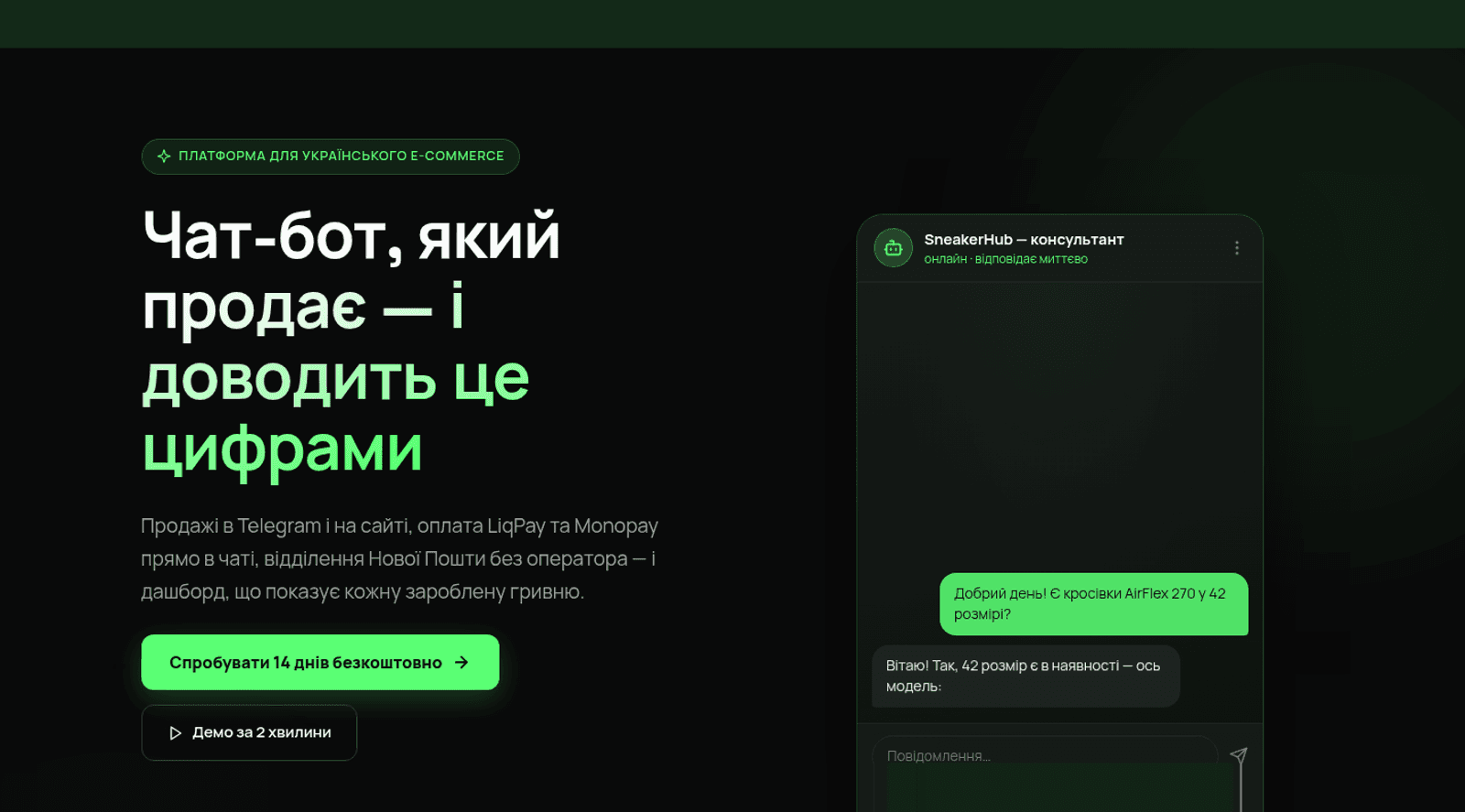
It answers from the store's knowledge base, completes orders with Nova Poshta delivery and payment right in the chat, and links paid orders back to the scenario, the broadcast and the channel.

Measured
  • 0.21 stime to first response of the product page at 153 KB of HTML7 September 2026 · external curl measurement from Ukraine
  • 0 lossesnot a single lost and not a single duplicated acknowledged message during a chaos test: 300 requests per second, with the engine, NATS and Redis killed by force17 August 2026 · k6 load test on a local full stack, not on production
  • 89.7 %accurate answers on a reference set of 45 questions, with no answer outside the knowledge base4 July 2026 · evaluation of the AI consultant on real OpenAI
What it does not do
  • It does not create demand: the bot works with people who have already written into the chat.
  • Only Telegram and the site widget work today. Instagram and Viber are planned, so LEO is not yet a fit for a store whose main channel is Instagram.
  • There are no integrations with KeyCRM, SalesDrive, GA4 or Meta CAPI — those are plans, not features. External systems are connected through webhooks and the public API.
  • The revenue report is an attribution model, not accounting: it shows that an order was paid after a dialogue, and it does not prove that the order would not have happened without the bot.
  • Card payment is switched on with the payment provider keys of the store itself, and a complex question — a custom price or a disputed return — is still closed by a person.

Textory

Product catalogue rewriting: a feed in, a feed out

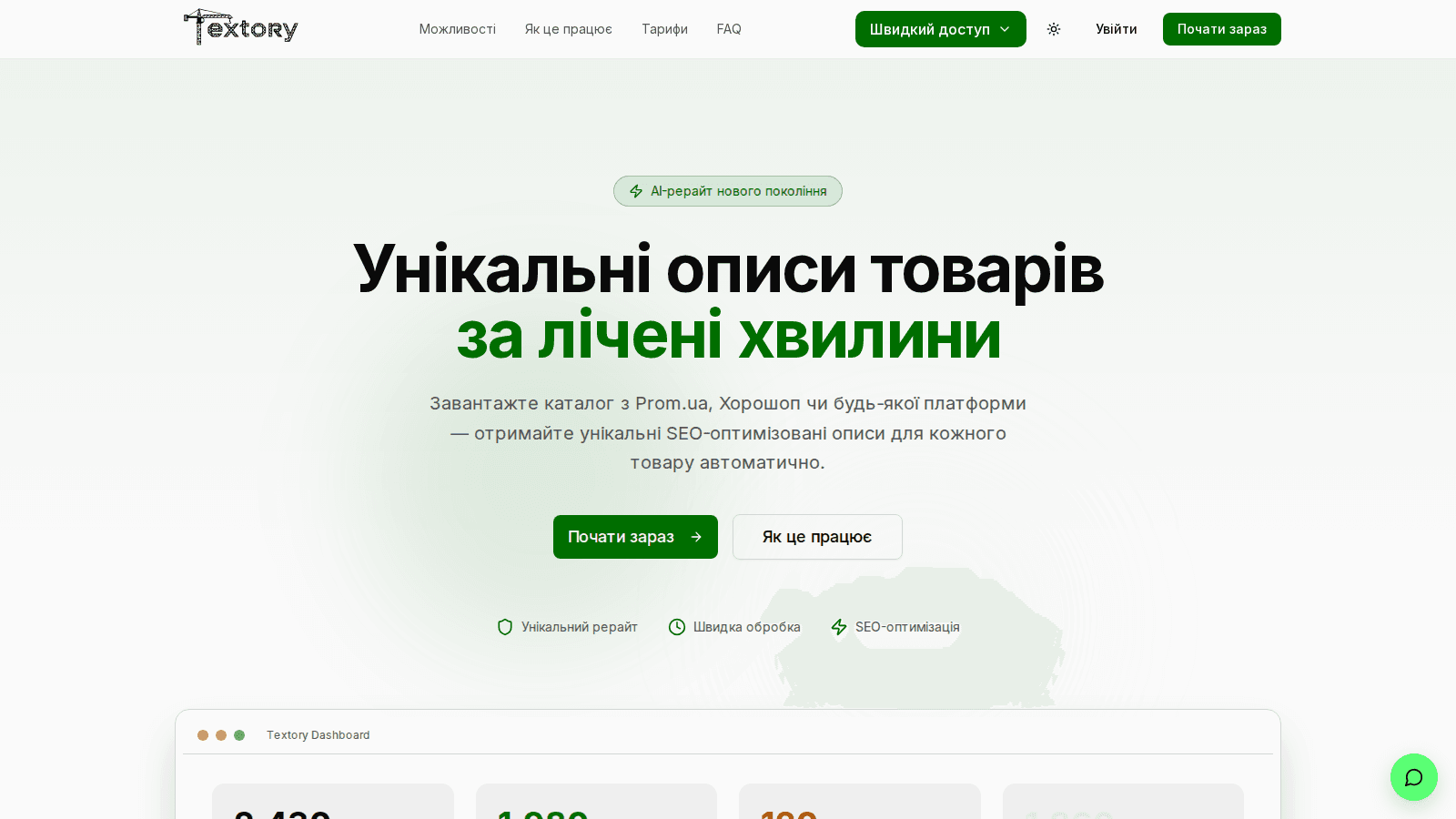
It reduces a catalogue from XML, YML, CSV or Excel to a single product model, rewrites the descriptions through Gemini and returns an import-ready feed in the format of your platform.

Measured
  • 0.22 stime to first response of the product page at 141 KB of HTML — the fastest result among the 16 sites we measured2 August 2026 · external curl measurement from Ukraine
  • 11 806 productsthe largest of the public demo catalogues on which the rewriting can be checked before working with your own feedpublic demo feeds on textory.com.ua
  • 0–100a deterministic GEO score for a description: it counts the direct answer in the first sentence, question subheadings, fact density and entities, instead of an AI grading itselfscoring mechanism, not a measurement
What it does not do
  • A unique description removes the technical loss from duplicates and thin content, but on its own it does not create demand and does not raise rankings: ranking is affected by assortment, prices, links and how people behave.
  • Nobody, ourselves included, can promise a mention in an AI answer. The GEO mode only makes a description structurally more suitable for citation.
  • A product with no description, or with a description shorter than 20 characters, is marked as skipped — there is nothing to rewrite.
  • For flagship and complex niche items, human editing after the rewrite gives a better result than a fully automatic pass.
  • Descriptions in other languages and Schema.org in the generated feed are plans, not existing features.

LiteShop

A Laravel store engine whose code stays with you

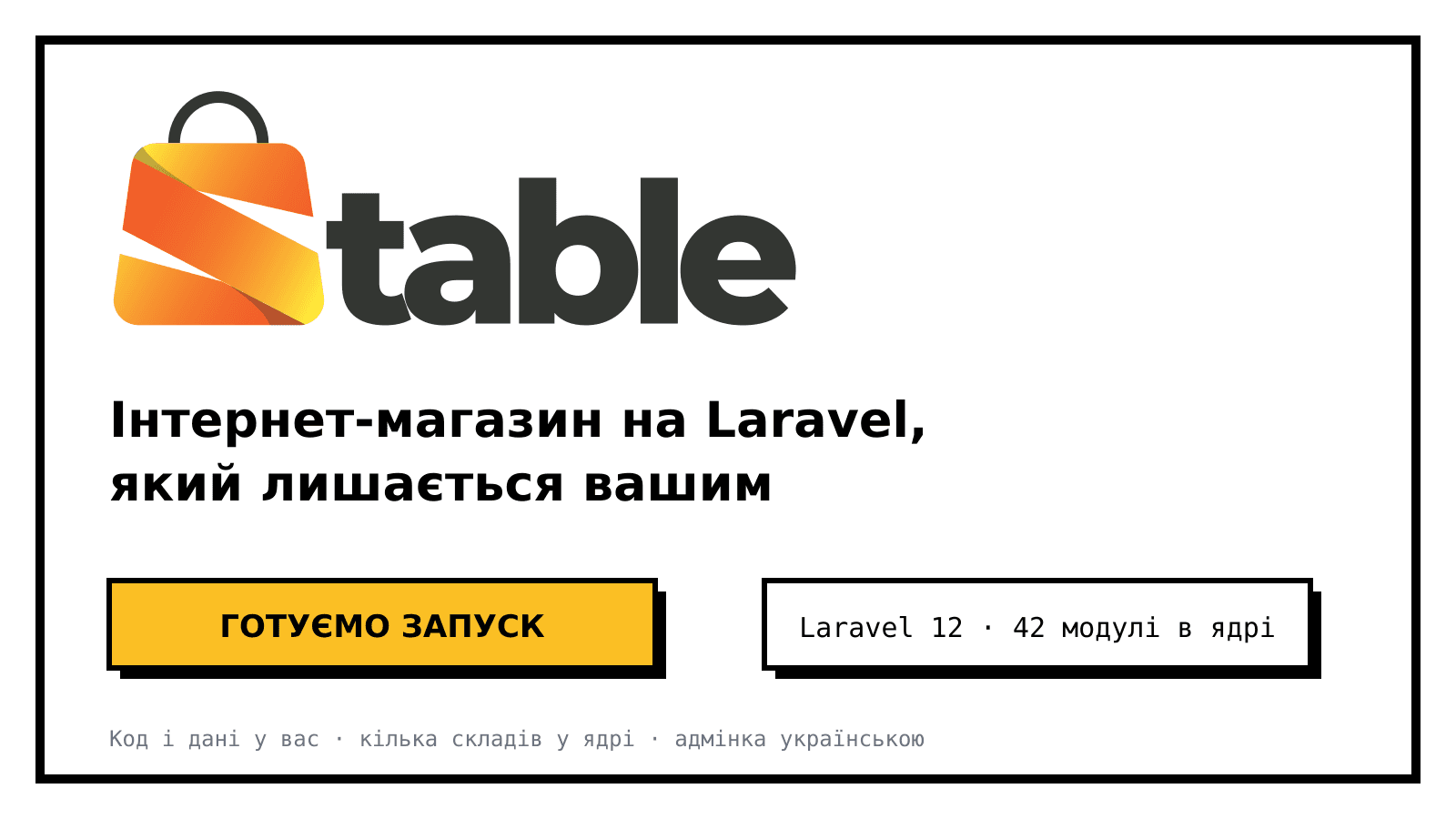
Several warehouses with a different price for the same product, wholesale price levels and stock accounting work in the core; the engine is installed on your server instead of being rented month by month.

Measured
  • 167 mstime to first response of the home page, cold equal to warm19 May 2026 · production of a car parts store, Hetzner cx43
  • 42 modulesin the core: delivery, payment, warehouse, loyalty, SEO — each switched on with a toggle in the admin panelmodule counter in the core
  • 98.3 %Redis cache hits with zero evicted keys12 June 2026 · production of a car parts store, Hetzner cx43
What it does not do
  • When LiteShop is not needed: one warehouse, a few hundred products and no plans for wholesale prices or custom work. Then renting a site builder will come out cheaper, and we say so in the first email, not after payment.
  • There is no cart reservation with a timer: stock is written off when the order is placed.
  • An extension store, extension points for third-party developers and a control panel for all instances are in development.
  • Rozetka Delivery and Meest are still stubs, there is no import from OpenCart, an English version of the storefront interface is planned, and the multilingual feature translates the content but not the storefront itself.
  • Carriers and payment gateways run on your own keys: the Nova Poshta or acquiring account is registered to the store, not to us.

KVED → NACE 2.1-UA

Your KVED-2010 code in the new NACE 2.1-UA classifier

It shows the new code in three ways: by the old code, through the full correspondence table, or by recognising the codes straight from an uploaded extract from the Unified State Register (EDR). Free, no registration.

Measured
  • 616 codeseach with a page of its own, 1 366 URLs in the sitemap in total2 August 2026 · our own measurement of the site
  • 349 peopleused the service between 1 July and 2 August 2026, 346 of them for the first time2 August 2026 · Google Analytics of the project
  • 244 mstime to first response of the server2 August 2026 · external curl measurement from Ukraine
What it does not do
  • The service shows how the codes correspond to each other, but it does not file any documents: changing the code in the register is something the business owner arranges themselves.
  • Recognition reads the codes from an uploaded document, but it does not verify whether they are still valid in the Unified State Register.
  • There is no registration and the service collects no personal data — which also means it keeps no history of your queries.
  • This is a reference tool, not a consultation: for the interpretation of a disputed code you need an accountant or the tax office.
Connections

How the products work together

They have no shared landing page: each one has its own domain and its own page. The connection is a single one — data from one product becomes the input for another.

LEO ChatTextoryLiteShopКВЕД → NACE 2.1-UA
  1. 01

    Descriptions become the basis for answers

    Textory rewrites the catalogue and publishes a feed in the Prom-YML format at a permanent address. LEO Chat picks that feed up as a catalogue source on a schedule, so the bot already answers with the new descriptions.

  2. 02

    Our own sites are served by our own bot

    The LEO Chat widget has been on lionex.com.ua since 4 July 2026 and on textory.com.ua since 7 July 2026, as two separate workspaces under one login. Writing to the bot in the corner of the page is the product demo.

  3. 03

    The store and the bot on one carrier key

    The Nova Poshta module in LEO Chat was ported from LiteShop: the same API, the same methods. That is why both run on one key of the store. The widget module in the LiteShop storefront and the catalogue feed for the bot are in progress.

  4. 04

    KVED → NACE stands apart

    A free public service with no code shared with the rest. It has one thing in common with them: the same showcase of our own products and the same Next.js stack.

Comparison

What to compare this with

In the tables on the product pages we compare mechanisms and categories of solutions, not brands.

LEO Chat · Comparison with the alternatives

About the product
LEO Chat: Comparison with the alternatives
CriterionLEO ChatA bot builder or a broadcast serviceA general-purpose AI chat on the site
What the report showsOrders paid after a dialogue, a scenario or a broadcast — by the last-touch model within a configured windowSubscribers, delivered messages, clicksDialogues and satisfaction ratings
Order checkoutCart, phone, branch, payment and waybill inside the chatMostly a button to the site or a formNone
DeliveryNova Poshta on the real API: cities, branches, parcel lockers, waybills, statuses into the chatThrough third-party connectorsNone
Payment for UkraineCash on delivery, Monobank, LiqPay on the store's own keysDepends on the plan and the regionNone
Catalogue sourceHoroshop and Prom.ua feeds, CSV, a scanner of the site's microdataPartly, through intermediate servicesNone
AI answersFrom the store's knowledge base with a link to the source; anything unknown goes to an operatorPresent in some services, usually as a separate optionPresent, on general knowledge
Channels todayTelegram and a widget on the siteA wider set of messengersThe site only

Textory · Comparison with the alternatives

About the product
Textory: Comparison with the alternatives
CriterionTextoryA generic AI writerA copywriter by handImporting descriptions as they are
Working with a product feedAccepts XML, YML, CSV, Excel or a link and returns a ready feed for the platformText in a chat, you assemble the feed yourselfNoneThe feed exists, but the descriptions are not unique
Catalogue scaleThousands of items in a queue, with pause and resumeOne by one or in small batchesMonths of workInstant
Ukrainian marketplacesThe name_ua and description_ua fields, export presets for Prom and RozetkaGeneral text without the target feed fieldsDepends on the contractor
SEO structureHeadings, specification lists, keywords and a meta description in a single callHave to be requested separately and formatted by handDepends on the contractorNone
Readiness for AI searchA GEO mode and a deterministic 0–100 scoreThere is no measurable indicatorNoneNone
PaymentFor the actual volume of textA subscription or tokens, not tied to the catalogueFor the contractor's time or volume
Catalogue dataAn NDA mode, catalogues are stored encrypted and do not go into AI trainingDepends on the policy of the serviceBy agreement

LiteShop · Comparison with the alternatives

About the product
LiteShop: Comparison with the alternatives
CriterionLiteShopRenting a site builderA theme for OpenCart
What stays with youThe source code and the data on your serverThe store lives on someone else's platform, the code is not handed overA skin on top of someone else's engine, the core is not yours
Several warehousesOne SKU across several warehouses, each with its own price, stock and delivery time; the order is split automaticallyDepends on the plan, usually one price per productA theme does not add this — it is engine logic
Wholesale pricesCustomer groups, several wholesale levels, personal prices per item, minimum order amountsUsually a separate, more expensive planNone
Stock accountingEvery stock movement as a separate record with an author and a timestamp; operations run in transactions with row lockingA basic stock number on the productNone
How the product is paid forA one-time purchase of the engine; the alternative is renting it on our hostingA monthly fee for as long as the store runsA one-time purchase of the skin, the engine separately
Who will be able to extend itAny Laravel developer: the stack is industry standard, with no home-made layersOnly within the settings of the platformA developer for OpenCart
Catalogue searchMeilisearch with Ukrainian lemmatisation; an SKU is found with spaces, hyphens and dotsThe built-in search of the platformDepends on the engine
Questions

What people ask most often

Why are there no prices here?

The plans for Textory and LEO Chat live on the sites of the products themselves: there they stay current, while a copy here would go stale. LiteShop is sold on a different model — a one-time purchase of the engine, with the code and the data staying with you; the alternative is renting it on our hosting. The cost of agency work we do not state publicly at all: a free review comes first.

Do you promise that a product will raise sales or rankings?

No. Each of them removes a technical loss: duplicate descriptions, questions left unanswered outside working hours, orders that never reached payment. How much of that turns into money depends on the assortment, the prices and how fast the managers are. Nobody guarantees search positions, and neither do we.

Which channels work in LEO Chat today?

Telegram and the widget on the site. Instagram and Viber are planned, so if the main channel of your store is Instagram, LEO is not a fit yet. You can check the widget right here: the same product works in the corner of this page.

When is LiteShop not needed?

If you have one warehouse, a few hundred products and no plans for wholesale prices or custom work — renting a site builder will come out cheaper, and we will say so in the first email, not after payment. LiteShop starts to make sense from two warehouses or suppliers, from a need for wholesale price levels, or when a site builder is already running into its limits.

Can I order an integration of a product into my own store?

Yes. Send the address of the store or an export of the catalogue — within 1–3 business days we will come back with a review: what transfers automatically, what will have to be done by hand, how many stages it takes. After that, an estimate by stage and a contract with a fixed amount. We reply within two hours during working hours.

Is KVED → NACE really free, and is registration required?

It is free, and there is no registration. It is a public service for the transition to NACE 2.1-UA: 616 activity codes, each with a page of its own, plus recognition of codes from an uploaded extract from the Unified State Register (EDR). Between 1 July and 2 August 2026 it was used by 349 people.

The next step

We will review your catalogue for free

Give us the address of the store or an export of the catalogue — within 1–3 business days we will come back with a review of the task. We reply within two hours during working hours, and the review commits you to nothing.

Fill in the brief